Why AI Output Quality Depends on Human-Defined Context
12 Min. Lesezeit

Why AI Output Quality Depends on Human-Defined Context
Key Takeaways
Better AI output usually comes less from producing more content and more from defining better context.
LLMs are trained on broad public knowledge. They still need project-specific standards, constraints, and examples to produce consistently useful results.
This article proposes two practical names for those foundations: Human Made Artifacts (HMAs) and Human Curated Artifacts (HCAs).
The goal is not to rename existing practices. It is to give teams a clearer way to identify, maintain, and improve the artifacts that shape AI quality.
Everyone is talking about models.
Which one is best? Which one is fastest? Which one is cheapest? Which one fits inside the context window?
Those questions matter. But in day-to-day AI work, they are often not the main thing that determines whether the result is actually useful. The bigger lever is usually the human-defined context around the model: the project rules, the examples, the boundaries, the reference material, and the definition of what a good result looks like.
That idea is already familiar. Prompt engineering, context engineering, style guides, system prompts, specs, review checklists, and reference examples all point in the same direction. What still feels undernamed is the broader class of artifacts that carry those decisions across tasks and over time.
This article proposes two simple terms for that class:
Human Made Artifacts (HMAs)
Human Curated Artifacts (HCAs)
The point is not to replace existing words like spec, guide, template, or documentation. Those describe formats. HMA and HCA describe a role: artifacts that encode human judgment in a reusable form that AI systems can work from.
That distinction matters because once teams see these artifacts as quality infrastructure rather than miscellaneous supporting material, they can manage them more deliberately.
The Real Bottleneck Is You, and That Is the Point
Generating a lot of content is no longer hard.
Anyone can ask an LLM to produce ten versions of an email, a code snippet, a spec draft, a set of tests, a diagram outline, or a markdown document in seconds. Quantity is cheap.
What is still hard is getting output that is:
relevant to your project
aligned with your standards
consistent across tasks
easy to review and reuse
correct often enough to save real time
That is the real bottleneck. Or more directly: the real bottleneck is you, and that is the point.
Not because humans are slow or in the way. The bottleneck exists because someone still has to define what quality means, which constraints matter, which tradeoffs are acceptable, and which outputs can be trusted. That work sits with the humans using the model.
Large language models are trained on broadly available data. They know many patterns. They do not know your architecture, your customer constraints, your team conventions, or your quality bar unless that information is made explicit.
This is where human-defined artifacts matter. They turn general model capability into project-specific usefulness. HMAs and HCAs are one practical way to externalize that human bottleneck into something reusable. Instead of restating judgment from scratch in every prompt or review cycle, teams can capture it in artifacts that make future AI work better.
What Are HMAs and HCAs?
The words are simple on purpose.
Human Made Artifacts (HMAs)
Human Made Artifacts are project-defining artifacts created by humans.
They can be documents, markdown files, diagrams, images, code, scripts, templates, checklists, rulebooks, style guides, specs, examples, config files, or any other artifact that captures decisions a human has made about what the project is and how work should be done. The key point is not the format. The key point is the human origin and the human judgment behind it.
Examples of HMAs:
a product or system specification
a test case rulebook
a coding standard or linter config
a brand voice guide
a set of approved architectural patterns
a requirements markdown file
a reference implementation
a folder of example outputs the team considers high quality
HMAs encode decisions that the model should not invent on its own.
Human Curated Artifacts (HCAs)
Human Curated Artifacts are artifacts that may have been generated or heavily assisted by AI, but were then reviewed, corrected, and validated by a human until they became trustworthy enough to reuse.
Examples of HCAs:
an AI-generated draft specification that was revised and approved by a domain expert
a generated test suite that was reviewed and corrected by senior engineers
an AI-assisted script that was validated and adopted by the team
a generated documentation page that was fact-checked and turned into an internal reference
If an HMA is human-authored from the start, an HCA is AI-assisted output that earned trust through human review.
In practice, HMAs and HCAs may function similarly once adopted. The difference is not mainly how they are used. The difference is their provenance and trust path. One begins with human authorship. The other becomes reusable through human validation.
Both matter because both can become durable context for future AI work.
Why Introduce New Terms at All?
This is the core case for the terminology.
Teams already have many names for individual artifacts: spec, runbook, template, playbook, style guide, reference implementation, example set, approved script.
What is often missing is a shared umbrella term for discussing them collectively as reusable inputs to AI quality. Without that umbrella, these artifacts are easy to treat as:
miscellaneous documentation
one-off prep work
side products of delivery
personal team habits rather than shared assets
That framing understates their role.
When AI is used repeatedly across code, documentation, research, planning, or operations, these artifacts are not peripheral. They are part of the operating system around the model. The value of HMA and HCA is not theoretical purity. It is practical clarity.
Once named, teams can ask better questions:
Which HMAs currently define quality in this workflow?
Which AI outputs are good enough to promote into HCAs?
Which artifacts are stale, weak, or contradictory?
Which missing artifacts are causing repeated review pain?
If a term helps teams identify, maintain, and improve the assets that shape AI quality, it has done useful work.
What the Evidence Supports
The sources behind this article support the broader context argument, even if they do not independently prove the HMA/HCA vocabulary.
Anthropic argues that context engineering is becoming a central discipline for building effective agents. Their formulation is especially relevant here: better outcomes come from curating the smallest possible set of high-signal context that best guides the model toward the desired result.
Gartner predicts that through 2026, organizations will abandon 60% of AI projects unsupported by AI-ready data. That does not directly validate the HMA/HCA framework, but it does reinforce the broader point that model quality depends heavily on the quality of the surrounding inputs and infrastructure.
In the 2025 Stack Overflow Developer Survey, 45.2% of respondents said debugging AI-generated code is more time-consuming. That does not prove weak context is always the cause, but it does support the practical reality that AI output often shifts work from creation to verification and cleanup.
Taken together, these sources support a narrower claim than hype-heavy AI discourse often makes:
model capability matters, but outcomes still depend heavily on the quality of the context, standards, and supporting inputs around the model.
What HMAs and HCAs Actually Do
HMAs and HCAs help LLMs in three practical ways.
1. They define what the project is
LLMs know general software patterns, general writing patterns, and general design patterns. They do not know what matters in your specific environment.
An HMA or HCA can tell the model:
what your domain means by
correctwhich constraints are non-negotiable
what formats are expected
which examples are considered good or bad
what should be escalated instead of guessed
2. They raise consistency
Without durable artifacts, every prompt starts close to zero. The same task gets explained differently by different people, and the model responds differently each time. Artifacts reduce that drift. They give the model a more stable baseline.
3. They make good output easier to get
Better artifacts do not eliminate review, but they usually reduce the amount of trial and error needed to get usable results. That is the practical value: better first drafts, fewer misunderstandings, and more reliable reuse.
From General Models to Project-Specific Quality
This is the shift the terms are meant to capture.
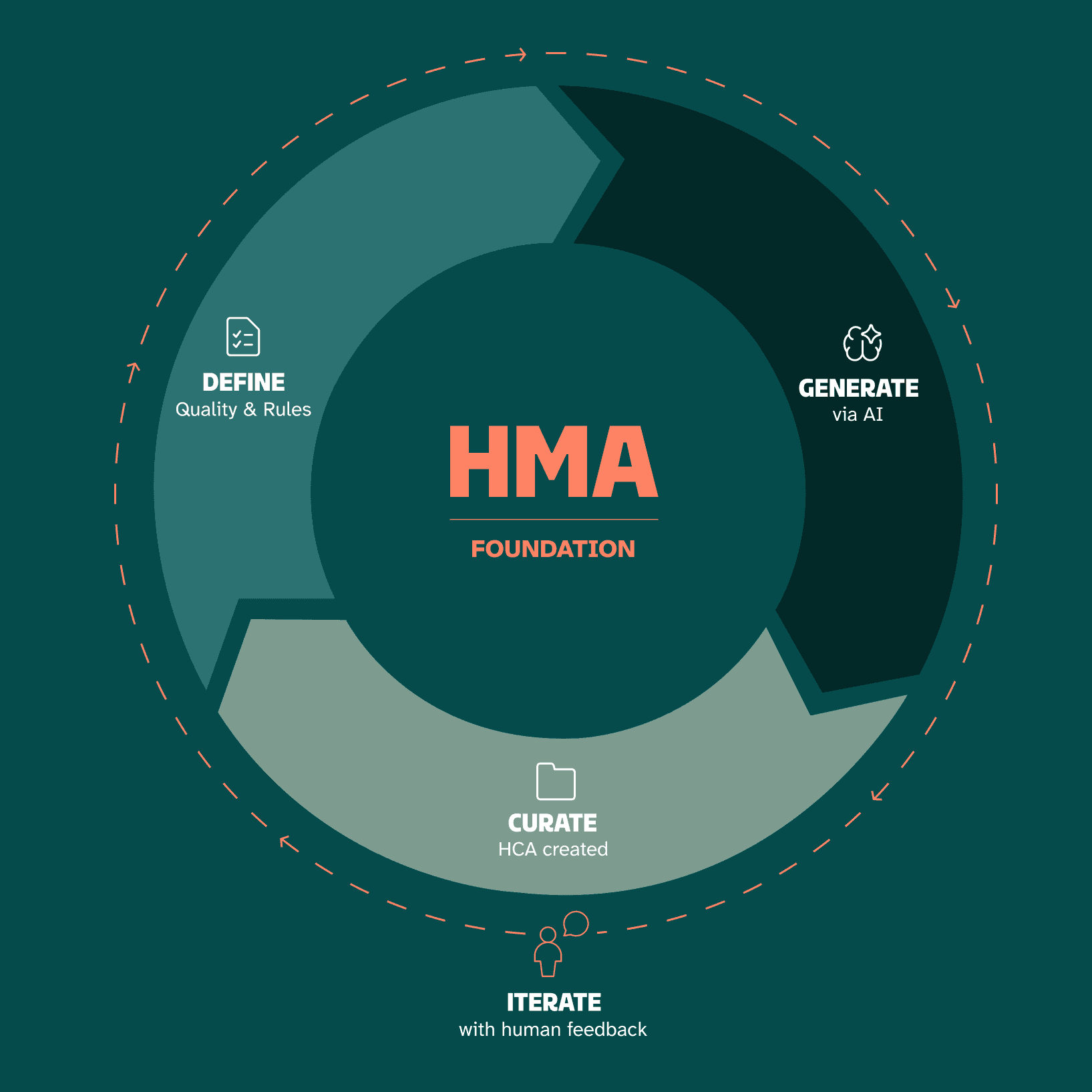
The HMA/HCA flywheel: humans define quality and rules, AI generates output, humans curate what is valuable, and that curated output improves future results.
An LLM starts with broad knowledge. An HMA narrows that knowledge into project-specific direction. An HCA turns reviewed AI output into reusable project-specific context.
That makes the workflow cumulative:
a human defines a standard, rule, or reference as an HMA
AI uses that artifact to generate output
a human reviews the result and promotes strong outputs into HCAs
those HCAs become additional grounded context for future work
This helps explain why AI often becomes more useful inside a team over time than in a cold-start demo. The team is not only using a model. It is building and maintaining a layer of project-specific artifacts that make the model more effective.
A Real Example From Our Work
We saw this clearly while building an AI-assisted test generation suite for a complex integration project between an ERP system and a warehouse management system.
This is one concrete example, not a claim that the pattern is limited to test generation. We have seen the same dynamic across projects and task types wherever AI is used seriously: output quality improves when the surrounding human-defined context becomes clearer, more reusable, and better maintained.
The work only became practical once that human context was made explicit.
The most important HMA was a test rulebook. It defined what a good test case should look like, how granular it should be, and what quality meant in practical terms. We also had a small set of strong human-written test cases as positive examples, and bad test cases as negative examples.
On top of that, we created HCAs with AI assistance. One defined what complete coverage should look like for specific interface sections. Later, corrected AI-assisted test cases were also promoted into HCAs and reused as trusted references. That changed the human role in the workflow. Instead of manually drafting every test case from scratch, people could focus on defining the rules, reviewing the outputs, and validating whether section coverage was actually strong enough.
That shift improved both speed and consistency. The AI was working against explicit standards instead of vague intent, and the human bottleneck did not disappear. It became reusable.
Examples Across Different Types of Work
This applies far beyond prompts or software development.
In software development
architecture decision records
linting and formatting rules
migration runbooks
example tests
repository conventions
approved scripts and templates
In content and marketing
brand voice documents
sample landing pages
review checklists
editorial style guides
approved image references
In operations or internal enablement
SOPs
workflow diagrams
escalation rules
policy checklists
validated internal scripts
The same pattern holds across all of them: the better the human-defined and human-curated artifacts, the easier it becomes to use AI without lowering the quality bar.
How to Start Building HMAs and HCAs
You do not need to document everything. Start where bad AI output is most expensive.
Ask:
What does a good result look like here?
What rules or constraints must always be followed?
Which existing files or examples already represent the standard?
What mistakes does AI repeatedly make in this area?
Which outputs are worth reviewing and promoting into trusted reusable references?
That is usually enough to identify your first useful HMAs and HCAs. The first version does not need to be big. A short markdown rulebook, a reviewed script, a good example set, or a validated checklist can already improve quality noticeably.
Frequently Asked Questions
Is this just another name for documentation?
Partly, but not exactly. Documentation is often descriptive. HMAs and HCAs are a broader category of project-defining artifacts that can be actively used by AI systems to generate or evaluate work. They are operational context, not just passive explanation.
Do HMAs have to be text files?
No. They can be text, code, images, diagrams, scripts, configs, templates, examples, or other artifacts. The format matters less than the fact that they encode human judgment in a reusable way.
Why create new terms if teams already use prompts, specs, and guides?
Because those are individual formats, not a shared category. HMA and HCA are useful umbrella terms for discussing the role these artifacts play in AI quality across different formats and workflows.
What is the difference between an HMA and an HCA?
An HMA starts with human authorship. An HCA becomes trustworthy through human curation. Both can become high-value context for future AI work.
Does this only matter for agentic AI?
No. It matters anywhere AI is used seriously. But it becomes even more important in agentic workflows, where reusable context and boundaries shape many actions over time rather than a single reply.
The Bottom Line
The important point is not that context matters. Most experienced AI users already know that.
The more useful point is that the human-defined and human-validated artifacts behind good AI work deserve to be treated as first-class assets. That is what the terms Human Made Artifacts (HMAs) and Human Curated Artifacts (HCAs) are meant to capture. LLMs bring broad capability. HMAs and HCAs define the project-specific reality that turns that capability into quality.
If AI-generated content is easy to produce, then quality is the real differentiator. And if quality is the differentiator, the artifacts humans create and curate may be the most valuable layer in the workflow.
Which human-defined artifacts have made the biggest difference in your AI workflow?